Wood Mold Cleanup: Does Vinegar Actually Work?
September 15, 2026
Dry Source Property Restoration


Blog
You spot a fuzzy gray patch on a wooden windowsill or the underside of a cabinet, and the first advice you find online is to grab a bottle of vinegar. It sounds simple, cheap, and natural, but before you start scrubbing, it helps to know whether using vinegar to clean mold on wood is truly effective or just a popular myth. Homeowners across our region ask this question often, and the honest answer involves a few important details. When mold spreads beyond a small surface stain, our team provides professional damage restoration services in Madison, WI to make sure the problem is handled correctly the first time.
Mold on wood is common in Wisconsin homes because of our humid summers, snowy winters, and the temperature swings that create condensation. Wood is porous and organic, which makes it an ideal food source for mold when moisture is present. Understanding how vinegar interacts with these surfaces can save you both time and frustration.
White distilled vinegar is a mild acid, and that acidity is what gives it mold-fighting properties. Research and years of practical experience suggest that vinegar can kill many common household mold species on hard, non-porous surfaces. Its acetic acid content disrupts the mold's structure and can prevent regrowth when the surface is kept dry afterward.
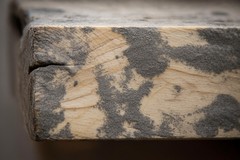
That said, vinegar is not a miracle cleaner. It works best on surface-level mold and light staining. It does not bleach away the discoloration that mold leaves behind, so even after the mold is dead, you may still see a shadow or stain on the wood. Vinegar also has limits when mold has established deep roots, which is exactly what happens on porous materials like untreated or aging wood.
Here is where the question of using vinegar to clean mold on wood gets complicated. Wood absorbs moisture and allows mold to send its microscopic roots, called hyphae, below the visible surface. When you wipe the top layer, you may remove what you can see, but the deeper growth can remain alive inside the grain. That is why mold sometimes returns days or weeks after a seemingly successful cleaning.
Sealed or finished wood, such as a coated table or a polyurethane-treated floor, behaves more like a non-porous surface. Vinegar has a better chance of fully removing mold from these because the growth stays on top. Raw, weathered, or water-damaged wood is a different story. On these surfaces, cleaning alone often is not enough, and the underlying moisture issue must be corrected to keep mold from coming back.
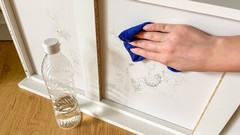
If you are dealing with a small patch of mold, roughly the size of a dinner plate or smaller, on a finished wood surface, a careful vinegar treatment can be worth trying. The goal is to kill the mold without soaking the wood and creating a new moisture problem.
Never mix vinegar with bleach, because the combination can create dangerous fumes. And resist the temptation to drench the wood, since excess moisture is the very thing that feeds mold in the first place. If the stain remains after the mold is gone, that is cosmetic and can sometimes be sanded or refinished later.
There are clear situations where a household approach falls short. If the mold covers a large area, keeps returning, or is accompanied by a musty smell that lingers throughout a room, you are likely dealing with growth that has penetrated deep into the material or spread behind walls, under flooring, or into framing. In these cases, relying on vinegar to clean mold on wood can give a false sense of security while the real problem continues to grow out of sight.
Health concerns matter too. Anyone in the home with asthma, allergies, a weakened immune system, or respiratory sensitivity should avoid disturbing mold, since cleaning can release large amounts of spores into the air. Structural wood, such as joists, subflooring, or wall studs showing mold, signals a moisture source that needs professional evaluation. Mold on structural elements is not just a cleaning issue; it can point to hidden leaks or long-term humidity problems that threaten the integrity of your home.
Water intrusion is one of the most frequent reasons mold takes hold on wood in the first place. If you have had a leak, a flood, or a plumbing failure, addressing the moisture is essential.
When mold has moved beyond a simple surface stain, professional remediation offers something a spray bottle cannot: proper containment, HEPA filtration, moisture detection, and a plan to prevent recurrence. Specialists identify the source of the moisture, remove affected materials safely, treat the remaining structure, and verify that the problem is genuinely resolved rather than temporarily hidden.
Our trained technicians handle everything from testing to full cleanup, and you can learn more about our approach to mold removal and mold remediation in Madison and across the region. We serve homeowners throughout Madison and the surrounding areas, and our process is designed to protect both your property and the health of everyone inside it. For those farther afield, we also provide mold removal and remediation in Oak Creek and neighboring communities.
So does vinegar work? For small, surface-level mold on finished wood, using vinegar to clean mold on wood can be a reasonable and affordable first step, as long as you protect yourself, avoid over-wetting the wood, and fix whatever caused the moisture. It kills many common molds, but it will not remove staining, and it cannot reach growth that has burrowed deep into porous or structural wood.
The most important takeaway is that visible mold is often a symptom of a larger moisture problem. Cleaning the spot you can see without addressing humidity, leaks, or condensation almost guarantees the mold will return. Pay attention to recurring growth, musty odors, and any signs of water damage, because those clues point to something that needs more than a quick wipe-down.
If you are unsure how serious your situation is, or if the mold keeps coming back despite your best efforts, do not gamble with your health or your home. Reach out to our team for a professional assessment and let us help you find a lasting solution that keeps your Wisconsin home safe, dry, and mold-free.
September 15, 2026
September 9, 2026
September 7, 2026
![[Homeowner Guide] Yard Waste in Madison, WI and Where to Dispose of It](https://www.unitedstatesbd.com/images/unitedstatesbdcom/bizcategories/22212/News/613023/homeowner-guide-yard-waste-in-madison-wi-and-where-to-dispose-of-it.jpg "'[Homeowner Guide] Yard Waste in Madison, WI and Where to Dispose of It' Featured Image")
September 3, 2026