Water Damage on Baseboard in a Bathroom: Could There Be a Hidden Leak?
November 7, 2026
Dry Source Property Restoration


Blog
That soft, discolored trim at the bottom of your bathroom wall rarely shows up out of nowhere. Water damage on baseboard in a bathroom is one of the most common early warning signs that moisture is collecting somewhere it should not be, and it often points to a problem hiding behind the wall or beneath the floor. Catching it early can mean the difference between a simple repair and a major remediation project, which is why so many homeowners call a damage restoration company in Madison and the broader region the moment they notice something off near the floor.
Bathrooms are built to handle water, but they are also full of connections, seals, and pipes that can fail quietly over time. When those failures start, the baseboard is frequently the first visible casualty because it sits right where moisture travels. The good news is that these clues are readable if you know what to look for.
Water follows gravity, and it tends to pool at the lowest point it can reach. When a leak develops inside a wall cavity or beneath a tile floor, that moisture wicks downward and outward until it reaches the baseboard, which is made of wood or MDF that absorbs water readily. Because the baseboard is porous and sits at the junction of the wall and floor, it acts almost like a sponge, soaking up moisture long before you might notice a problem anywhere else in the room.
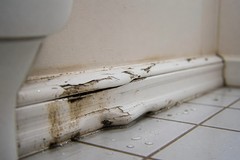
This is actually helpful. The baseboard becomes an early indicator, giving you a chance to investigate before the damage spreads into drywall, subflooring, or framing. When you see swelling, peeling paint, dark staining, or a spongy texture along the bottom of the wall, your home is telling you that water has been present for a while and needs attention.
Finding water damage on baseboard in a bathroom usually means tracing the moisture back to its source, and bathrooms offer several likely culprits. The most frequent is a failing seal around the toilet base. When the wax ring under a toilet deteriorates, water escapes with every flush and seeps into the floor, often emerging near the nearest baseboard.
Supply lines and shutoff valves behind the toilet or under the sink can develop slow drips that go unnoticed for months. Grout and caulk around tubs and showers break down over time, allowing water to slip behind the tile and into the wall cavity. Shower pans can crack, and drain connections can loosen, both of which release water beneath the floor where you cannot see it. Even a poorly sealed window or an undersized exhaust fan can contribute, since trapped humidity condenses and runs down the walls to the baseboard.
Each of these sources leaves slightly different clues. A toilet leak often produces damage concentrated on one wall near the fixture, while a shower or tub problem tends to affect the wall shared with the wet area. Paying attention to where the damage is worst can help you and a professional narrow down the origin faster.
Discolored trim is the obvious signal, but it is rarely the only one. Before the damage becomes severe, your bathroom usually drops hints that something is wrong. Being attentive to these can save you considerable money and stress.
Any one of these on its own warrants a closer look. When several appear together, it is a strong sign that moisture has been active behind the scenes for some time. Mold can begin growing within a day or two of persistent dampness, so the window for easy cleanup is shorter than many people expect.
What makes water damage on baseboard in a bathroom so concerning is not the trim itself, which is inexpensive to replace. It is what the damaged baseboard represents. Behind that trim, moisture may be feeding mold growth inside the wall cavity, rotting the bottom plate of the framing, or soaking into the subfloor where it weakens the structure. These problems are invisible until someone opens the wall, and they tend to worsen the longer they go untreated.
Mold is the most pressing concern because it affects both your home and your health. Spores spread quickly in dark, humid spaces, and a small patch behind a baseboard can expand into a wall-wide issue. If you suspect this has already started, professional mold removal and remediation in Madison is the safest path, since disturbing mold without proper containment can release spores throughout the home.
The first step is to stop adding water to the problem. If you can identify the likely source, such as a leaking supply line, shut off the valve. Dry the visible area as thoroughly as you can and keep the room ventilated. Then resist the urge to simply repaint or replace the baseboard, because cosmetic fixes trap the real issue inside the wall and allow it to grow.
A thorough assessment is essential. Professionals use moisture meters and thermal imaging to find where water is hiding without tearing apart your bathroom unnecessarily. They can measure how far the moisture has traveled, determine whether the subfloor or framing is compromised, and dry the affected areas properly before any rebuilding begins. Dry Source offers full water damage restoration in the Madison area that addresses the source, the structure, and the cosmetic repair as one complete process.
Acting quickly also matters for your insurance. Many policies cover sudden water damage but may deny claims tied to long-neglected leaks, so documenting the problem early and bringing in a qualified team strengthens your position considerably.
Once the damage is repaired, a few simple habits keep it from returning. Reseal grout and caulk around tubs and showers every year or so, and replace it the moment you see gaps or discoloration. Run your exhaust fan during and after every shower to control humidity, and check under the sink and behind the toilet periodically for the earliest signs of a drip. These small checks take only minutes and catch problems while they are still cheap to fix.
If you are in Deerfield, Madison, or the surrounding areas and notice water damage on baseboard in a bathroom, do not wait for the problem to reveal itself in a larger way. Whether you need an inspection, drying, or full reconstruction, prompt attention protects your home and your budget. Dry Source also provides water damage restoration in McFarland and neighboring communities, so help is close no matter where you are. Reach out for a professional evaluation and get peace of mind that the issue is truly resolved, not just hidden behind fresh paint.

November 1, 2026
October 23, 2026